GB/T 28181 public security video surveillance requirements
Terminology:
GB/T 28181-2022: Technical requirements for information transmission, switch and control of the security and protection video monitoring network system
Issuing bodies:
Issuing authority: Standardization Administration of China (SAC) Proposed by: Science and Technology Information Bureau of the Ministry of Public Security Administered by: National Technical Committee 100 on Security and Protection Alarm Systems (SAC/TC100) Drafted by: The First Research Institute of the Ministry of Public Security and other organizations
Release dates:
GB/T 28181-2011: released on 2011-12-30, implemented on 2012-06-01 GB/T 28181-2016: released on 2016-07-12, implemented on 2016-08-01, abolishing the 2011 version GB/T 28181-2022: released on 2022-12-30, implemented on 2023-07-01, abolishing the 2016 version
Changes of the 2022 version compared with the 2016 version:
Terms deleted: for example, the definitions of "monitoring point" and "monitoring center" were deleted.
Terms changed: the terms and definitions of "SIP monitoring domain", "non-SIP monitoring domain", "cascade" and "interconnection" were changed.
Abbreviations added: the abbreviation "PTZ" was added.
Interconnection structure diagram changed: the "SIP monitoring domain interconnection structure diagram" was changed.
Communication protocol structure diagram changed: the "networking system communication protocol structure diagram" was changed.
An RTP timestamp requirement for media stream data transmission was added, ensuring the authenticity and real-time performance of the video time.
The network transmission bandwidth requirement and the video frame rate requirement were changed. For example, the 2016 version had specific numerical requirements for the access bandwidth of a single channel, while the 2022 version is more flexible — it is enough to meet the requirement with a margin left; the frame rate is uniformly required to be 25 fps (the 2016 version had several frame rate requirements).
Supported encoding formats: support for H.265, AAC and G.722.1 was added. Here our 2016 version was extended to support H.265; if other platforms do not support it, it means the standard was not extended.
Queries and response commands such as guard position information query, cruise track list query, cruise track query, PTZ precise status query and storage card status query were added, refining and extending the function query capability of the system.
Subscription and notification of PTZ precise position change events were added, improving the real-time monitoring and feedback capability of PTZ control.
Device software upgrade, image snapshot signaling procedures and protocol interfaces were added, improving the maintenance and management functions of the system.
The security requirements for transmission, switch and control were changed, improving the security performance of the system.
To address the problem of insufficient ID encoding space in public security video networking applications, the standard extends the "coding rules for administrative division codes below the county level" and sorts out the industry coding comparison table.
The "registration redirection requirement" was added to support the load balancing mechanism, enhancing the throughput of the central platform.
The "protocol version identifier" was added, so as to distinguish the standard version information of the actual platform application over time, and to improve the compatibility and iterative capability of video networking application systems.
Example figure:
Meaning of the fields for our device registration on the platform:
ucFD_Enable="1": function enabled and sub-stream uploaded; "0": function disabled; "129": function enabled and main stream uploaded ucFD_Version="1": GB28181 version 2022; "0": GB28181 version 2016 ucFD_TcpSip="0": SIP over UDP; "1": SIP over TCP ucFD_TcpMedia="0": media over UDP; "1": media over TCP ucFD_AutoGps="0": position data needs to be subscribed; "1": position data is sent automatically ucFD_TalkChn="0": voice channel auto; "1": voice channel CHN strFD_Manufacturer="BBC": device manufacturer strFD_ModelName="M51Hv": device model strFD_ServerIp="139.9.251.220": server IP or domain name usFD_ServerPort="6608": server port strFD_ServerID="34017101041328000012": server ID strFD_ServerDomain="3401710104": server domain strFD_DeviceId="281812016": device ID usFD_DevicePort="5888": device port strFD_DeviceUser="34017101041328000012": authentication user name strFD_DevicePass="123456": authentication password SUBDEVID_0 strFD_LensId="": configure the ID of the first channel SUBDEVID_1 strFD_LensId="": configure the ID of the second channel, and so on
Required parameters and their purpose (related to device registration)
Device ID (strFD_DeviceId): "strFD_DeviceId="": device ID" Used to uniquely identify a device, ensuring the uniqueness and identifiability of the device on the platform. Some manufacturers create the device, server and authentication user IDs identically, for example the Hikvision platform.
Device manufacturer (strFD_Manufacturer) and device model (strFD_ModelName): "strFD_Manufacturer="BBC": device manufacturer; strFD_ModelName="M51Hv": device model" Provides the manufacturer and model information of the device, helping the platform manage and maintain the device. If the device side does not fill it in, some platforms create a default value for normalization, so this is also a required field — it is just that sometimes our device side does not fill it in. Ask the platform vendor whether it must be filled in.
Server IP address or domain name (strFD_ServerIp): "strFD_ServerIp="139.9.251.220": server IP or domain name" Specifies the server address of the GB/T 28181 platform that the device needs to connect to, in order to establish communication.
Server port number (usFD_ServerPort): "usFD_ServerPort="6608": server port" Specifies the port number used when the device connects to the server, used to distinguish different services and applications.
Authentication user name (strFD_DeviceUser) and authentication password (strFD_DevicePass): "strFD_DeviceUser="34017101041328000012": authentication user name; strFD_DevicePass="123456": authentication password" Used for the identity authentication of the device, ensuring the security and legitimacy of the device when connecting to the platform and preventing unauthorized devices from accessing the platform.
This is an important part of SIP server registration authentication. The 2011 and 2016 versions had loose authentication and some fields did not need to be filled in; the 2022 version requires authentication, so confirm the version and the authentication information with the platform vendor.
SIP protocol type (ucFD_TcpSip) and media protocol type (ucFD_TcpMedia): "ucFD_TcpSip="0": SIP over UDP; "1": SIP over TCP ucFD_TcpMedia="1": media over UDP; "1": media over TCP"
The recommended default is ucFD_TcpMedia="1" (TCP). Do not change it. If the two-way talk does not work, consult our technical support.
Other important parameters
Video encoding selection (ucFD_Enable): "ucFD_Enable="1": function enabled and sub-stream uploaded; "0": function disabled; "129": function enabled and main stream uploaded" Indicates whether the device uploads the sub-stream or the main stream. Upload different types of streams according to actual needs.
Position data parameter (ucFD_AutoGps): "ucFD_AutoGps="0": position data needs to be subscribed; "1": position data is sent automatically" Indicates whether the device automatically sends position data. For application scenarios that need to monitor the device position, it depends on the vendor's implementation.
Voice channel parameter (ucFD_TalkChn): "ucFD_TalkChn="0": voice channel auto; "1": voice channel CHN"
The recommended default is ucFD_TalkChn="0" (auto). Do not change it. If there is no sound on the device side during two-way talk, consult our technical support.
Channel configuration parameter (SUBDEVID_ strFD_LensId): "SUBDEVID_0 strFD_LensId="": configure the ID of the first channel" Configures the ID of a specified channel (video, audio, alarm). Some manufacturers do not create the device first; after the 20-digit parameter is filled in, the platform adds it automatically when it goes online.
Meaning of the parameters on the WEB page:
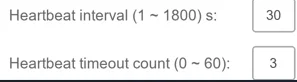
Heartbeat interval
The heartbeat interval is the time interval at which the device sends heartbeat messages to the national standard platform. This parameter determines how often the device sends a heartbeat to the platform, so as to confirm the online status of the device and the validity of the connection.
By sending heartbeat messages regularly, the national standard platform can monitor the online status of the device. If the device does not send a heartbeat message within the specified time, the platform may consider that the device is offline or that there is a problem with the connection.
Heartbeat timeout count
The heartbeat timeout count is the maximum number of consecutive heartbeat message timeouts allowed for the device. If heartbeat messages time out consecutively for the set number of times, the national standard platform may consider that the device has failed or that the connection has been disconnected.
The heartbeat timeout count setting helps the platform judge the connection status of the device more accurately. If the device is temporarily unable to send heartbeat messages due to network problems or other reasons, but the timeout count has not reached the set threshold, the platform will still consider the device to be online.
By adjusting the heartbeat timeout count, the fault tolerance and stability of the system can be improved to a certain extent. When the network condition is unstable or the device may have a temporary failure, appropriately increasing the heartbeat timeout count can reduce the device offline situations caused by misjudgment.
Server description:
SIP server
The SIP (Session Initiation Protocol) server is one of the core components of the national standard GB28181 platform. It is mainly responsible for device registration, signaling interaction and session management.
Media server
The media server in the national standard GB28181 platform is mainly responsible for the processing, storage and forwarding of streaming media data. It usually works together with the SIP server to jointly implement the functions of the video surveillance system.
Server domain description:
"strFD_ServerDomain="8000012": server domain"
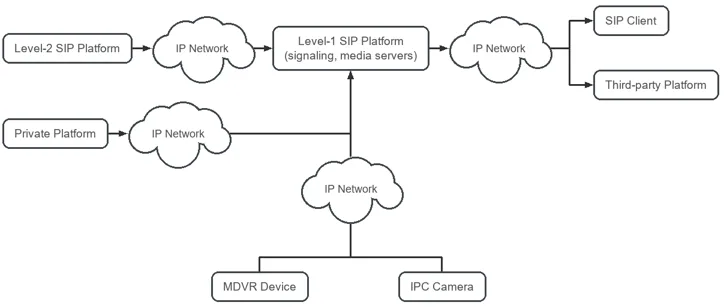
The SIP monitoring domain (that is, the server domain) is a basic 28181 communication model, which includes the front-end SIP devices (such as cameras, NVRs and lower-level platforms), the central signaling control server, the streaming media server, and the SIP client and the signaling security routing gateway at the presentation layer.
It is a concept in the SIP protocol used to identify a server or a service scope. The server domain is often used in the device registration process, as key information for the device to find and access the corresponding SIP server. At the same time, the server domain also helps the routing and forwarding of signaling, ensuring that signaling can reach the target device correctly and in time.
The server domain usually consists of the first 10 digits of the SIP server ID. For the definition of the specific registration information, ask the vendor.
Encoding ID description:
The national standard code, the device code ID and the video channel code ID are 20-digit decimal numbers. The composition and rules of the ID code depend on the specific implementation and context. For example, it may require that the 11th, 12th and 13th digits are 111 or 123; the manufacturers confirm the device type in their implementation design.
Screenshots of online material describing the encoding ID in detail:
National standard encoding ID
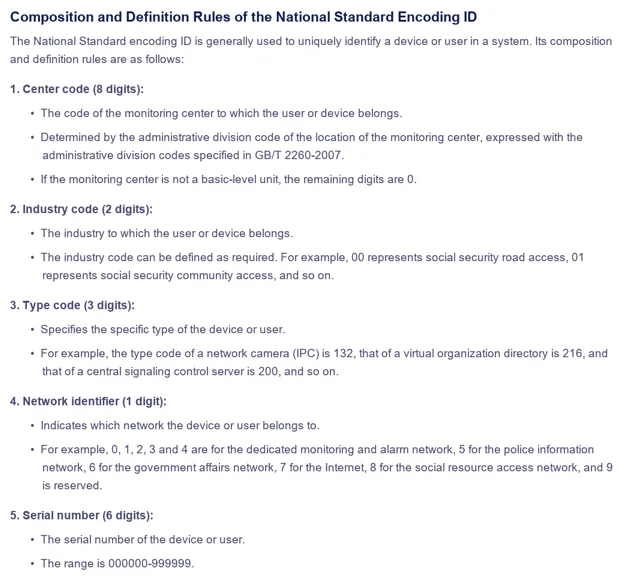
Device encoding ID

Video channel encoding ID
