WLAN (WiFi) protocol standards
Description
Wi-Fi is a transmission technology of the wireless local area network (WLAN), based on the standard formulated by the Institute of Electrical and Electronics Engineers (IEEE) for wireless local area networks: the 802.11 protocol.
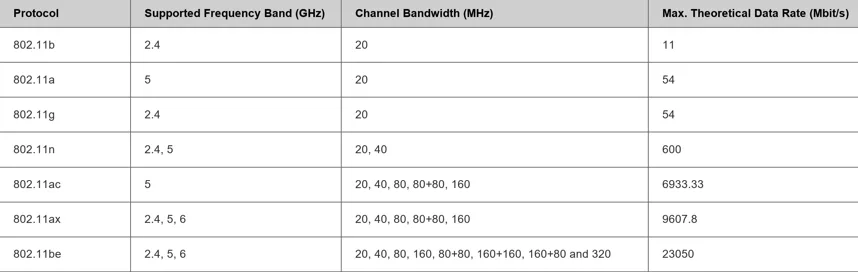
WLAN follows the 802.11 protocol standard, from the earliest 802.11a/b/g, through 802.11n (Wi-Fi 4), 802.11ac (Wi-Fi 5), 802.11ax (Wi-Fi 6/Wi-Fi 6e), to the latest 802.11be (Wi-Fi 7). Each evolution has brought a leap in data transmission rate.
Frequency range and channels
The IEEE 802.11 protocol standard specifies the frequency bands and channels to be used, and each country formulates its own policy on which channels to use.
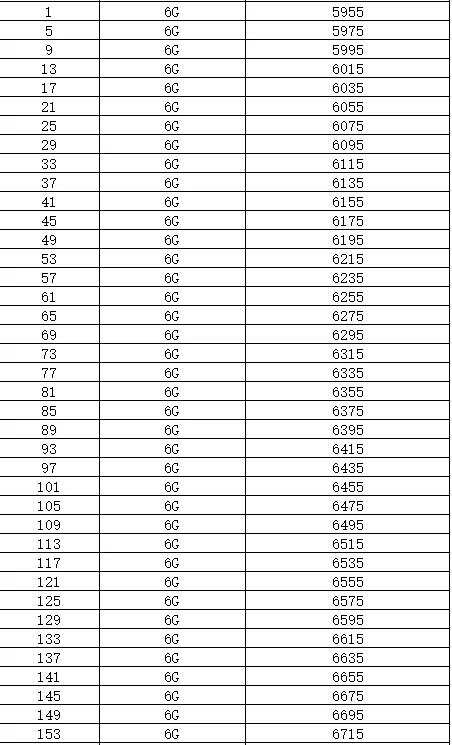
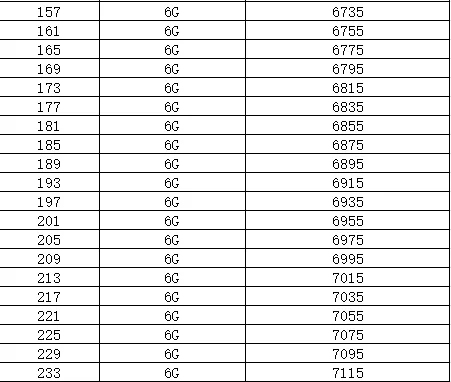
IEEE 802.11 protocol provisions for the 6GHz band:
Frequency range: 6GHz band, with a total of 1200MHz of spectrum used for WiFi 6E, ranging from 5.925GHz to 7.125GHz.
Main standard: an extended version based on IEEE 802.11ax (that is, WiFi 6), also known as WiFi 6E.
IEEE 802.11 protocol provisions for the 2.4GHz band:
Frequency range: 2.4GHz ~ 2.4835GHz; 14 channels, channel bandwidth 20M (the frequencies of multiple adjacent channels overlap). The frequency range of 22M shown below is because 2M is used as a mandatory isolation band and does not participate in data transmission.
IEEE 802.11 protocol provisions for the 5GHz band:
Frequency range: 5.150-5.250GHz, 5.250-5.350GHz, 5.470-5.725GHz, 5.745-5.825GHz; 201 channels in total, channel bandwidth 40M/80M/160M (selectable, the frequencies of multiple adjacent channels overlap).
China's provisions for the Wi-Fi 2.4GHz band:
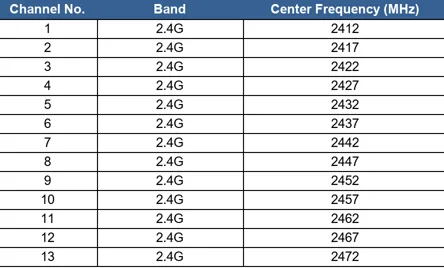
Frequency range used: 2.4GHz ~ 2.4835GHz, with a total bandwidth of 83.5MHz. The corresponding channels are as follows:
| Channel | Center frequency | Frequency range |
|---|---|---|
| 01 | 2412 | 2401-2423 |
| 02 | 2417 | 2406-2428 |
| 03 | 2422 | 2411-2433 |
| 04 | 2427 | 2416-2438 |
| 05 | 2432 | 2421-2443 |
| 06 | 2437 | 2426-2448 |
| 07 | 2442 | 2431-2453 |
| 08 | 2447 | 2436-2458 |
| 09 | 2452 | 2441-2463 |
| 10 | 2457 | 2446-2468 |
| 11 | 2462 | 2451-2473 |
| 12 | 2467 | 2456-2478 |
| 13 | 2472 | 2461-2483 |
The bandwidth of each channel is 22MHz, and the center frequency interval between adjacent channels is 5MHz. The frequencies of multiple adjacent channels overlap (for example, channel 1 overlaps in frequency with channels 2, 3, 4 and 5). Within the whole band, there are only 3 non-interfering channels (1, 6 and 11). Therefore, when using Wi-Fi devices in the 2.4GHz band, multiple devices that are close to each other should use different channels to prevent mutual interference.
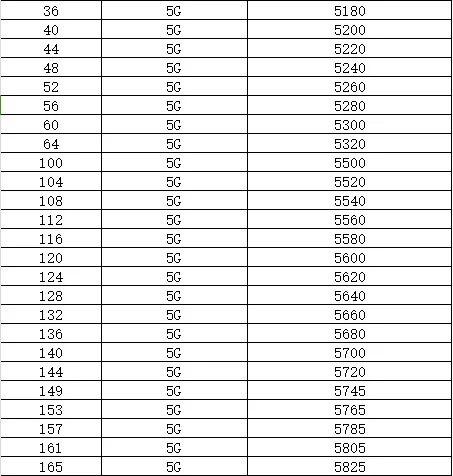
China's provisions for the Wi-Fi 5GHz band:
Frequency range used: 5.150GHz ~ 5.350GHz and 5.725GHz ~ 5.850GHz, with a total bandwidth of 325MHz. The corresponding channels are as follows:
| Channel | Center frequency | |
|---|---|---|
| 036 | 5180 | DFS |
| 040 | 5200 | DFS |
| 044 | 5220 | DFS |
| 048 | 5240 | DFS |
| 052 | 5260 | DFS |
| 056 | 5280 | DFS |
| 060 | 5300 | DFS |
| 064 | 5320 | DFS |
| 149 | 5745 | |
| 153 | 5765 | |
| 157 | 5785 | |
| 161 | 5805 | |
| 165 | 5825 |
Latest detailed channel distribution diagrams
2.4G WIFI
5G WIFI
4.9G WIFI

6G WIFI